
How to Make a Will in India: A Complete Legal Guide
By Adv (Col) Raj Kumar
Making a Will is one of the most important yet commonly postponed legal acts in India. A properly drafted Will ensures that your assets are distributed according to your wishes, minimizes family disputes, and provides legal certainty after your lifetime. This article is intended to be a one-stop, comprehensive guide covering all legal aspects of Will-making in India, written in clear and practical terms.
1. What Is a Will?
A Will is a legal declaration of a person’s intention regarding the distribution of their property after death.
Under Section 2(h) of the Indian Succession Act, 1925, a Will is defined as:
“The legal declaration of the intention of a testator with respect to his property which he desires to be carried into effect after his death.”
The person making the Will is called the Testator (male) or Testatrix (female).
2. Why Is a Will Important?
A Will helps to:
* Ensure your assets go to the people you choose
* Avoid family disputes and litigation
* Appoint guardians for minor children
* Appoint an executor you trust
* Prevent intestate succession under personal laws
* Speed up the legal transfer of assets
Without a Will, property is distributed as per intestate succession laws, which may not reflect your wishes.
3. Who Can Make a Will in India?
Legal Requirements
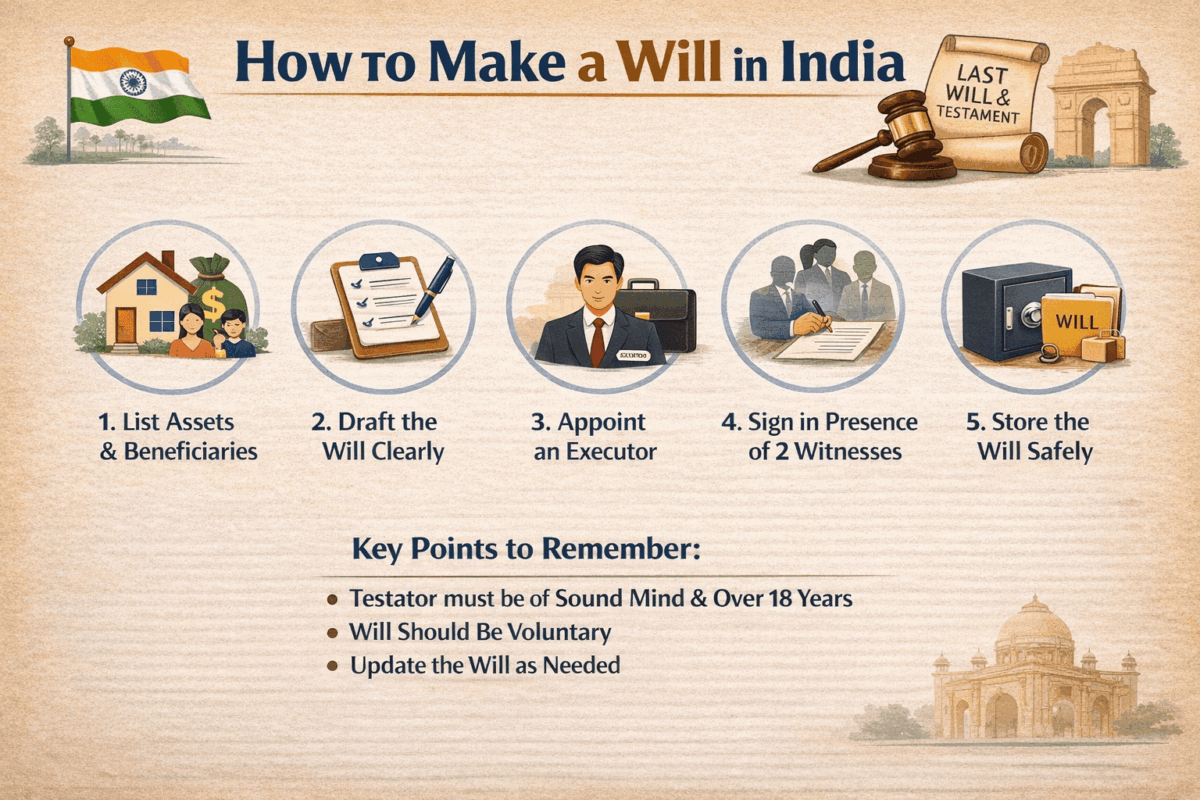
Under Section 59 of the Indian Succession Act, 1925, a person can make a Will if:
* They are at least 18 years old
* They are of sound mind
* They are making the Will voluntarily
* They understand the nature and effect of the document
A Will made under coercion, fraud, or undue influence is invalid.
4. Applicable Laws Governing Wills in India
(a) Indian Succession Act, 1925
Applies to:
* Christians
* Parsis
* Jews
* Interfaith marriages (unless governed otherwise)
* Hindus, Sikhs, Jains, and Buddhists for procedural aspects
(b) Hindu Succession Act, 1956
Governs inheritance when a Hindu dies without a Will (intestate).
A Hindu has complete freedom to dispose of self-acquired property by Will.
(c) Muslim Personal Law (Shariat)
Muslims are governed by:
* Muslim Personal Law (Shariat) Application Act, 1937
Key limitations:
* A Muslim can bequeath only up to one-third (1/3rd) of their estate by Will
* Bequests beyond 1/3rd require consent of legal heirs
* A Muslim cannot bequeath property to legal heirs without consent
5. What Property Can Be Bequeathed?
You can include:
* Self-acquired immovable property (house, land)
* Bank accounts
* Fixed deposits
* Shares and mutual funds
* Insurance proceeds
* Jewellery and valuables
* Intellectual property
* Digital assets (with access instructions)
Ancestral property (in Hindu law) can only be bequeathed to the extent of your share.
6. Essential Elements of a Valid Will
A legally valid Will must contain:
1. Clear declaration that it is your last Will
2. Personal details of the testator
3. List of assets with clear descriptions
4. Details of beneficiaries
5. Mode of distribution
6. Appointment of executor
7. Appointment of guardian for minor children (if applicable)
8. Date and place of execution
9. Signature of the testator
10. Attestation by two witnesses
7. Role of Witnesses
* Minimum two witnesses are mandatory
* Witnesses must:
* Be adults
* Be of sound mind
* See the testator sign the Will
* Witnesses should not be beneficiaries (to avoid legal complications)
8. Executor of the Will
An executor is responsible for:
* Carrying out the instructions in the Will
* Applying for probate (if required)
* Settling debts and distributing assets
You may appoint:
* A trusted individual
* A professional (lawyer or chartered accountant)
9. Is Registration of a Will Mandatory?
No. Registration is NOT mandatory.
However, registration under the Registration Act, 1908:
* Adds authenticity
* Reduces chances of dispute
* Preserves the Will safely with the Sub-Registrar
An unregistered Will is fully valid if properly executed.
10. Stamp Duty on Wills
* No stamp duty is payable on Wills in India
* This makes Will-making legally inexpensive
11. Probate of a Will
Probate is a court certification confirming the validity of a Will.
When is Probate Mandatory?
Probate is generally optional but often required by banks and institutions.
12. Can a Will Be Changed or Revoked?
Yes.
A Will can be:
* Revoked at any time during the testator’s lifetime
* Modified by executing a Codicil
* Automatically revoked by making a new Will
The latest Will always prevails.
13. Types of Wills in India
* Privileged Will – For soldiers, airmen, and mariners in active service
* Unprivileged Will – Ordinary Will
* Joint Will
* Mutual Will
* Conditional Will
* Sham Will (invalid)
Oral Wills are generally not recognized, except in limited privileged cases.
14. Nomination vs Will
A common misconception:
* Nominee is not the owner
* Nominee is only a trustee
* The Will overrides nomination
Legal heirs mentioned in the Will have final rights.
15. Tax Implications of a Will
* India has no inheritance tax or estate duty
* Assets received through a Will are not taxable
* Income generated from inherited assets may be taxable
16. Safe Custody of the Will
Options include:
* With the testator
* With a lawyer
* Bank locker
* Registration office
* Informing executor of its location
17. Common Mistakes to Avoid
* Vague descriptions of assets
* Not updating the Will
* Excluding legal heirs without clarity
* Improper witnessing
* Not appointing an executor
* Assuming nomination replaces a Will
18. Should You Consult a Lawyer?
While handwritten Wills are valid, professional legal drafting ensures:
* Compliance with law
* Clear language
* Reduced litigation risk
* Proper estate planning
For complex assets or blended families, legal advice is strongly recommended.
Conclusion
A Will is not just a legal document—it is a responsibility. Drafting a clear, legally valid Will ensures peace of mind, protects your family, and preserves your legacy. In India, the law strongly supports testamentary freedom when the Will is properly executed.
If you have assets, dependents, or specific wishes, there is no “right age” to make a Will—only the right time is now.
Disclaimer: This article is for informational purposes only and does not constitute legal advice. Professional consultation is recommended for individual cases.